Gearbox Adaptation – DSG, S-tronic, ZF 8HP, 7G/9G-Tronic
Gearbox adaptation is a calibration of the TCM control unit during which the gearbox learns the current operating parameters of its clutches and hydraulics. The procedure is mandatory after every mechatronic unit repair, oil change, clutch replacement or software update — without it the gearbox jerks, shifts harshly or drops into limp mode.
We carry out the adaptation without a trip to the main dealer, using the manufacturer's own software (Launch and Topdon). We cover every common gearbox: DSG, S-tronic, ZF 8HP, 7G-Tronic, 9G-Tronic, PowerShift, CVT and classic torque-converter automatics. The job takes 30–60 minutes, and when it comes with a repair it is included in the price of the main service.
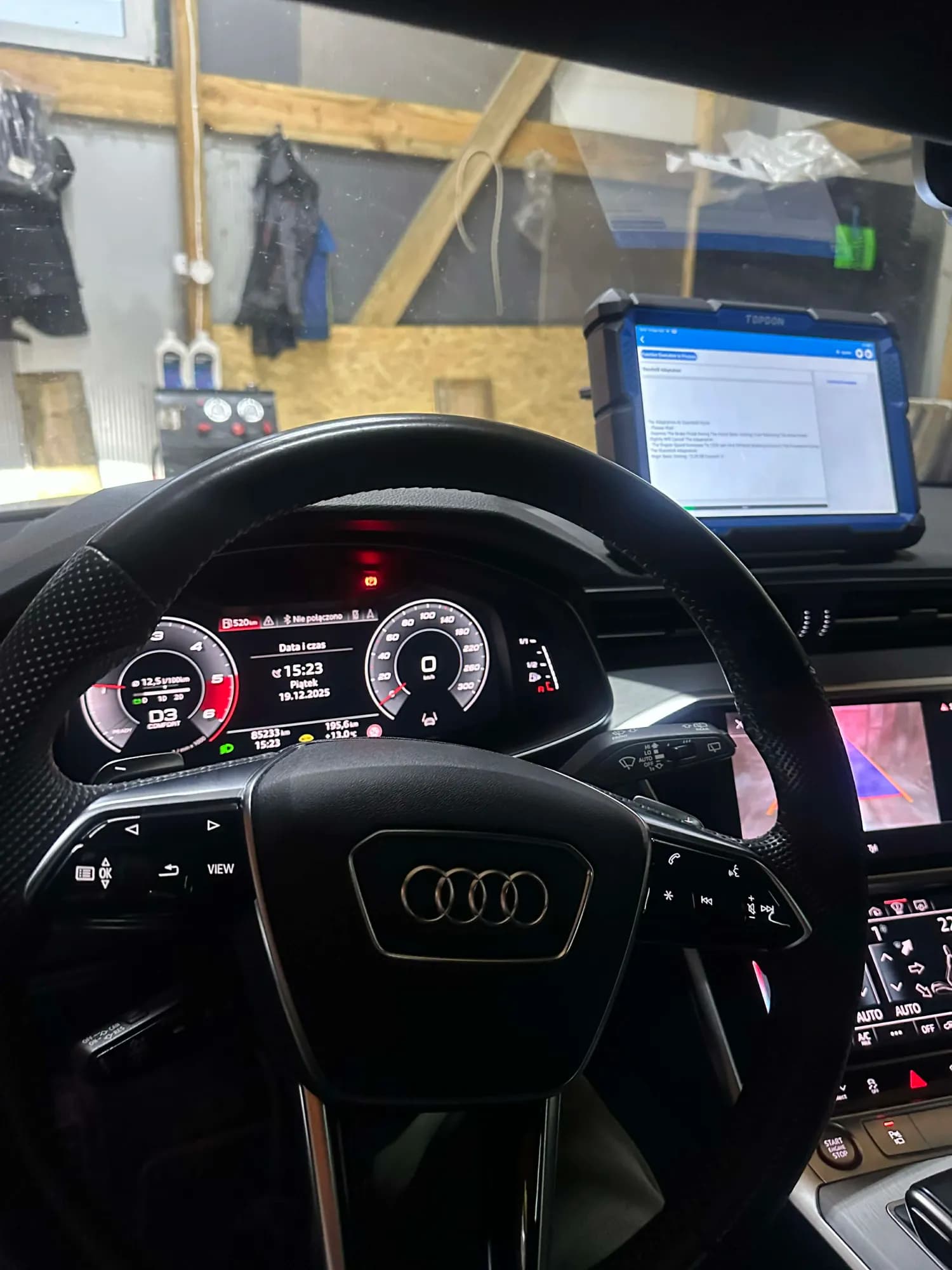
What is gearbox adaptation?
Gearbox adaptation is the process of programming and calibrating the control unit of an automatic gearbox (TCM – Transmission Control Module). During the process the control unit "learns" new operating parameters, matching the shift points, the oil pressure and other characteristics to the current condition of the gearbox components. The adaptation values are written to the control unit's non-volatile memory and read back every time the vehicle is started.
Why is adaptation needed?
Over time the parts inside an automatic gearbox wear naturally. Clutches, friction plates, solenoids and other components change their properties, which can affect shift quality. Adaptation lets the control unit compensate for those changes and keep the gearbox working at its best — with no parts replaced, purely by retuning the control algorithm.
When does a gearbox need adaptation?
Gearbox adaptation matters most in the following situations:
- After a gearbox repair – replacing internal components calls for the system to be recalibrated.
- After an oil and filter change – fresh oil has different viscosity properties, which changes the pressure in the system. We often combine adaptation with a dynamic oil change.
- After a TCM repair or replacement – a new control unit has to be programmed to work with that particular gearbox. When the swap involves transferring data from the original TCM, we carry out TCU cloning.
- When there are shifting problems – harsh shifts, delays or jerking — typical of the DQ250 DSG and the 0B5 S-tronic DL501.
- After a software update (flash) – every new SW version calls for re-adaptation, because the control maps and the shift thresholds change.
- After the vehicle has stood for a long time – when the car has not been used for a while and the adaptation values no longer match reality.
Symptoms of incorrect adaptation
Incorrect gearbox adaptation can show up in a number of ways:
- Harsh, abrupt gear changes
- Delayed response to the accelerator
- The car jerking as the gears change
- Incorrect engine revs during a shift
- Constant shifting back and forth between gears (hunting)
- The gearbox dropping into limp mode
The gearbox adaptation procedure
Gearbox adaptation covers the following stages. We use professional software from established brands: Launch and Topdon, which guarantees a precise and safe adaptation:
- Initial diagnostics – reading the fault codes and the state of the system with professional diagnostic software.
- Adaptation value reset – clearing the old learned parameters using the manufacturer's own software.
- Basic calibration – setting the basic operating parameters with specialist equipment.
- Road test – the learning procedure under real driving conditions, with the parameters monitored in real time (rev ranges, loads, oil temperature).
- Final verification – checking that the adaptation is correct and confirming optimal operating parameters on the scanner.
Adaptation of DSG, S-tronic, ZF 8HP and 7G/9G-Tronic
Every gearbox family has its own adaptation procedure – different tools, different rev thresholds, different learning times. Below we go through the cases we see most often:
DSG (DQ200, DQ250, DQ381, DQ500)
DSG gearboxes need adaptation of the K1/K2 clutch bite points, of the fill values (Touchpoint Adaptation) and of the pressure curves. We run the procedure in ODIS or VCDS – after a clutch or mechatronic unit replacement the adaptation is mandatory, otherwise the gearbox will judder as it pulls away and codes P17BF/P189C will appear. For details of the popular 6-speed version see DQ250 (02E) DSG.
S-tronic (DL382, DL501)
The S-tronic in an Audi (A4/A5/A6/A7/Q5) uses a wet clutch and an electric pump. Adaptation covers the clutch actuator, the accumulator pressures and the engagement curves – after an actuator or mechatronic unit repair the gearbox goes straight back into limp mode unless it is adapted. For a full description of the service see 0B5 S-tronic (DL501).
ZF 8HP (BMW, Range Rover, Audi, Jaguar)
The ZF 8HP (8HP45/8HP70/8HP90) is one of the most "forgiving" gearboxes when it comes to adaptation – in many cases a reset of the values in ISTA (BMW), or the Land Rover/Jaguar equivalent, is enough and the control unit relearns on its own during normal driving. After a ZF mechatronic unit replacement, a full adaptation reset and a road test of around 50 km are recommended.
7G-Tronic / 9G-Tronic (Mercedes)
The 7G-Tronic 722.9 and the newer 9G-Tronic 725 need an adaptation in XENTRY after every replacement of the VGS control unit (the control board inside the gearbox). Without a properly executed adaptation the gearbox can be slow to engage D/R and downshift harshly. The procedure itself takes around 30 minutes.
Electronic gearbox adaptation — when it is enough, and when a repair is needed
Electronic gearbox adaptation is another name for the software calibration of the TCM control unit — retuning the clutch fill times, the pressures and the shift points without any mechanical work inside the gearbox. We carry out electronic adaptations for every common family of automatic gearbox: DSG, S-tronic, ZF 8HP, 7G/9G-Tronic, PowerShift, CVT and classic torque-converter automatics — always with the manufacturer's own software (Launch and Topdon).
An electronic adaptation on its own solves the problem only when the cause is electronic — adaptation values that have drifted out of step after an oil change, a mechatronic unit repair, a TCM replacement or a software update. If the gearbox is jerking because of worn clutches, a failed mechatronic unit or a low oil level, calibration alone will bring no more than a temporary improvement. That is why we always run diagnostics before an adaptation, to settle whether electronic retuning is enough or a mechanical repair is needed — an S-tronic mechatronic unit rebuild or a clutch replacement, for example.
The benefits of a correct adaptation
A properly executed gearbox adaptation brings the following benefits:
- Smooth gear changes – no more jerks or harsh shifts
- Optimal fuel consumption – better-tuned shift points
- A longer gearbox life – less wear on the components
- Better driving comfort – more predictable gearbox behaviour
- Fault codes cleared – electronic problems resolved
Why leave it to professionals?
Gearbox adaptation is a complex process that calls for specialist knowledge and the right diagnostic equipment. In our workshop we use the original software of established brands: Launch and Topdon, which guarantees a precise and safe gearbox adaptation. We also work with customers who need gearbox software modification after a repair or an engine tune. An incorrectly executed adaptation can lead to:
- Poorer shift quality
- Increased wear on the gearbox components
- Problems with the vehicle's electronics
- Having to repeat the whole process
Prices and turnaround
The adaptation on its own is usually 30–60 minutes of work on the diagnostic bay, plus a short road test. Every job is quoted individually: the price depends on the gearbox model, the scope of work (adaptation alone vs adaptation after a repair) and whether licensed manufacturer software has to be used. On combined jobs — a mechatronic unit rebuild, an oil change, a TCM replacement — the adaptation is included in the price of the main service or charged at a preferential rate. We give an exact quote over the phone once you tell us the make, model and gearbox type.
Getting here and the area we cover
Our workshop is in Deszkowice Drugie (Sułów commune, Zamość county, Lublin Province, Poland). Customers from Zamość reach us in around 20 minutes, from Biłgoraj in around 30 minutes, from Lublin in around an hour and from Dęblin in around an hour — over those distances most drivers bring the car in themselves for the adaptation and collect it the same day. From Warsaw our customers usually arrange transport on a trailer — at around 250 km the trip is worth making for larger repairs combined with an adaptation (a mechatronic unit rebuild, a clutch replacement), not for the calibration on its own.
Summary
Gearbox adaptation is a key part of keeping an automatic gearbox working at its best. Carrying the procedure out regularly, and above all after repairs or component replacement, preserves shift smoothness, driving comfort and a long gearbox life.
If you have noticed problems with the way your automatic gearbox behaves, or you need an adaptation after repair work, get in touch. We have the professional diagnostic equipment and the experience this job takes.
Frequently asked questions
What is gearbox adaptation and why is it carried out?
Gearbox adaptation is a procedure in which the TCM control unit learns the current hydraulic and mechanical parameters of the gearbox — clutch fill times, pressures and shift torques. After a repair, an oil change or a software update the old adaptation values no longer match the real condition of the components, which results in harsh shifts, jerking or limp mode. A completed adaptation restores smooth gearbox operation without a trip to the main dealer.
When is adaptation of an automatic gearbox necessary?
Adaptation of an automatic gearbox is necessary after any work that affects the clutches or the hydraulics: after an oil and filter change, after a mechatronic unit repair or rebuild, after DSG/S-tronic clutch replacement, after a TCM replacement and after a manufacturer software update. Adaptation is also recommended when symptoms of wear appear — harsh shifts, delayed engagement of D/R, jerking or fault codes such as P17BF and P189C.
How long does gearbox adaptation take?
Gearbox adaptation usually takes 30–60 minutes on simpler gearboxes with a reset-and-relearn procedure (ZF 8HP, 7G-Tronic and 9G-Tronic, for example). Wet-clutch DSG and S-tronic units need a longer procedure — resetting the values in the control unit, a road test within a set range of revs and loads, and verification on the scanner — up to around 2 hours in total. Most vehicles are ready for collection the same day.
Can the adaptation be done without a main dealer?
Yes – gearbox adaptation can be carried out in full outside a main dealer. We use the manufacturers' own software: ODIS for the VAG group, ISTA for BMW, XENTRY for Mercedes, Tech2/GDS2 for Opel and GM, and VCDS for older VAG vehicles. The procedures are identical to those at an authorised workshop, and the cost is significantly lower. For most DSG, S-tronic, ZF 8HP and 7G/9G-Tronic gearboxes a main dealer is not needed.
Which automatic gearboxes do we adapt?
We adapt every common automatic gearbox: DSG DQ200/DQ250/DQ381/DQ500 (VW, Skoda, Seat), S-tronic DL382/DL501 (Audi), ZF 6HP and 8HP (BMW, Range Rover, Jaguar, Audi), 7G-Tronic 722.9 and 9G-Tronic 725 (Mercedes), Aisin AWF8F35/TF-80SC, PowerShift MPS6/DCT450 (Ford, Volvo), Jatco JF015E/JF016E CVT, Hyundai/Kia A6MF/A8LR and older classic torque-converter automatics 4HP/5HP/01M.
Will adaptation cure a jerking gearbox if no parts are replaced?
Adaptation on its own can cure a jerking gearbox only when the adaptation values have drifted out of step with the actual condition of the clutches — typically after an incomplete oil change, after a loss of power to the control unit or after the car has stood for a long time. If the cause is worn clutches, a failed mechatronic unit or a low oil level, adaptation will bring no more than a temporary improvement. That is why we always run diagnostics before an adaptation, to confirm that the problem is electronic rather than mechanical.
How much does adaptation of an automatic gearbox cost?
The cost of adapting an automatic gearbox is set individually and depends on the gearbox model and the scope of work (adaptation alone vs adaptation after a repair). On combined jobs — an oil change, a mechatronic unit rebuild, a TCM replacement — the adaptation is included in the price of the main service or charged at a preferential rate. We give an exact quote over the phone once you tell us the make, model and gearbox type.
Can I drive to the workshop from Lublin, Zamość or Dęblin?
Yes – our workshop is in Deszkowice Drugie (Sułów commune, Zamość county, Poland), around 20 minutes from Zamość, around an hour from Lublin, around 30 minutes from Biłgoraj and around an hour from Dęblin. Customers from nearby towns usually drive the car in themselves. From Warsaw our customers normally arrange transport on a trailer — at around 250 km the trip is worth making for larger repairs combined with an adaptation.
Do you carry out electronic gearbox adaptations for customers from Warsaw?
Yes – electronic gearbox adaptations, meaning the calibration of the TCM control unit with the manufacturer's own software, are also carried out for customers from Warsaw and the Mazovia region. Our workshop is in Deszkowice Drugie (Sułów commune), around 250 km from Warsaw, so driving over for the adaptation alone rarely pays. Customers from Warsaw usually combine the adaptation with a larger repair (a mechatronic unit rebuild, a clutch replacement) and arrange transport on a trailer — the electronic adaptation is then carried out on site, after the repair, before the vehicle is collected.